
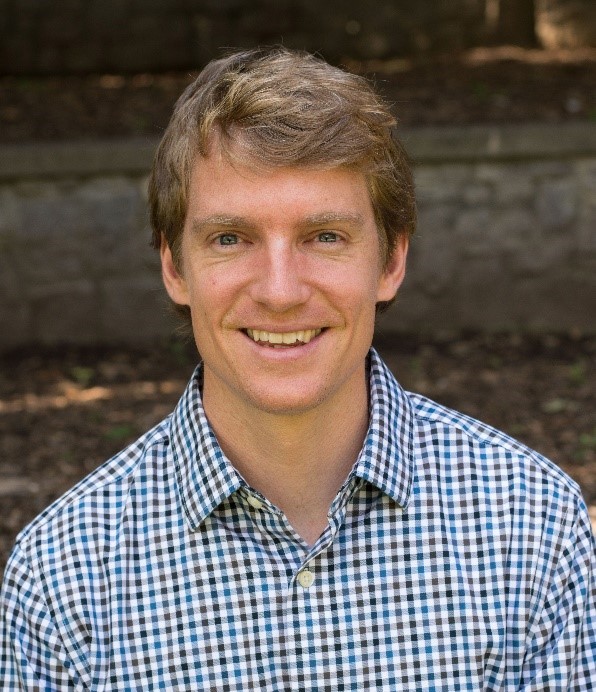
Jesse McDaniel, Associate Professor, School of Chemistry and Biochemistry, Georgia Tech
"Organic Electrosynthesis: Computational Predictions of Cation Radical Reaction Mechanisms and Kinetics within the Electrical Double Layer"
Abstract:
Electrosynthesis, using applied voltage or current to mediate desirable synthetic transformations of organic molecules, can proceed via either catalytic or non-catalytic pathways, depending on substrate, electrode material, and reaction conditions (applied voltage, etc.). The kinetics and mechanistic questions are very different for these complementary pathways: for catalytic (inner-sphere) pathways, mechanistic questions focus on the “surface science” and surface reactions on the catalytic electrode; in contrast for non-catalytic (outer-sphere) pathways, the reactive species are solution-phase radicals/ions, that undergo rapid and spontaneous reactions. In the latter case, the mechanistic questions concern the kinetics of competing solution-phase, reaction pathways for radical/ion reactions; these kinetics are often governed by small activation barriers with very large rate constants (e.g. k~108-1010 s-1) that are difficult to probe experimentally.
We will discuss recent progress in our research program in the development and application of multi-scale quantum chemical modeling approaches for computational prediction of reaction mechanisms and heterogeneous reaction kinetics of electrogenerated cation radical intermediates at electrochemical interfaces. We have explored key mechanistic questions involving how electric fields and high ionic concentrations within the electrochemical double layer modulate the reaction kinetics of such electrogenerated radical ion intermediates. We will discuss case studies of anodic arene C-H functionalization and olefin functionalization reactions, highlighting cases in which solvation effects within the electrical double layer can significantly alter reaction selectivity via kinetic control of product branching.
Bio:
Jesse McDaniel is an Associate Professor in the School of Chemistry and Biochemistry at Georgia Tech. He earned his B.A. from Washington University in St. Louis in 2008, and a Ph.D. in Physical Chemistry from the University of Wisconsin-Madison (with J.R. Schmidt) in 2014. From 2015-2017, he was a postdoctoral researcher with Arun Yethiraj at the University of Wisconsin. His research interests include the first-principles modeling of chemical reactivity within condensed-phase environments, with a particular focus on electrochemical systems and development of novel computational electrochemistry methods and algorithms. Major research effort is focused on organic electrosynthesis, targeting understanding radical ion reactivity as modulated by complex electrochemical environments, and prediction of heterogeneous kinetic rate parameters that are important for optimizing reaction yield/selectivity. He is the recipient of an NSF-CAREER award in 2023.